
Simulation framework for experimentally-observed spin-valley locking in MoS2 quantum dots
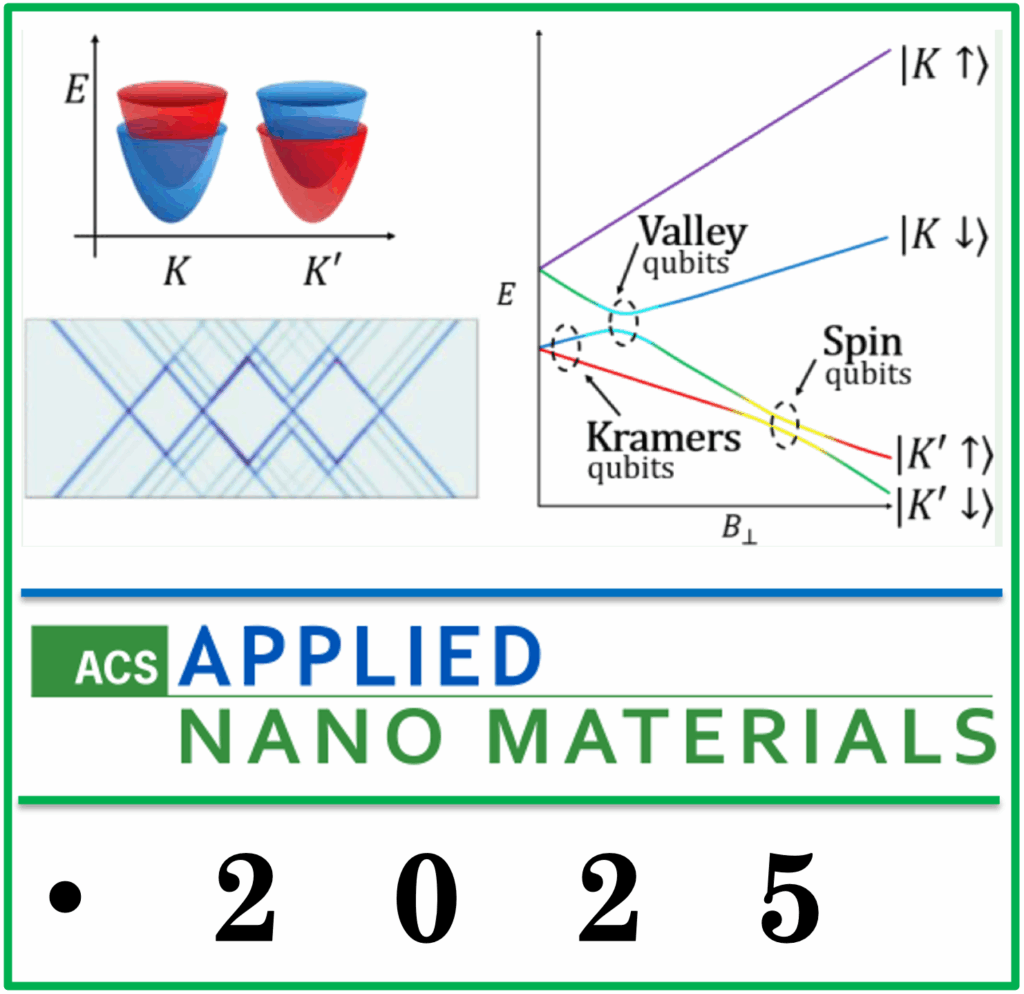
The spin-valley qubit promises significantly enhanced spin-valley lifetimes due to strong coupling of the electrons’ spin to their momentum (valley) degrees of freedom. In transition-metal dichalcogenides (TMDCs), such spin-valley locking is expected to be particularly strong owing to the significant intrinsic spin–orbit coupling (SOC) strength. Very recently, a few experiments on TMDC quantum dots have shared evidence of spin-valley locking at the few-electron limit. Employing quantum transport theory, we numerically simulate the ground- and excited-state transport spectroscopy signatures of these experiments under diverse conditions through a unified theoretical framework and reveal the operating conditions, based on intrinsic properties, for spin-valley locking. Based on our model, we extract four critical device material parameters to characterize and quantify the degree of spin-valley locking based on the SOC strength, intervalley mixing, and the spin and valley g-factors. The analytical framework and the numerical platform can be applied to qubit applications, such as designing transport spectroscopy experiments and subsequently characterizing the quantum dots through the extraction of device parameters. The unified method for characterization can help in meaningful comparisons across TMDC material platforms. In addition, our framework provides vital insights for the next challenge of experimentally confirming spin-valley and valley relaxation times by using single-shot projective measurements.


